One day, I was out with three other EWB folks. As the four of us walked down the street, we passed a young man who flashed us broad grin and pointed down the line from David, to Parker, to Louis and to me and said "
White.
White.
White.
(pause)
ORANGE!"
ORANGE?!?!?!
I thought that those of us of chinese persuasion were yellow.
This reference to me being orange happened again today.
Maybe I'm getting a bit of a sunburn....
Saturday, May 26, 2007

Sunday, May 13, 2007
Happy Mother's Day
 Chiyombwe household, Malama community
“Mulibwuia Buti” I greet Madame Chiyombwe with a small curtsey and she returns a small smile, a gentle handshake and a softspoken “Kabutu’. I tried to read the somewhat restrained and emotionless face, and as I came up empty handed, a part of me wondered what the next few days were really going to be like and if much of it would be spent in silence.
I arrive at the house, and look around me to and see the tin roof on the main house, four mud brick thatch roofed houses, maize in the three sheds, the ox ploughs, a latrine, plenty of chickens, pigs, cattle, a well, and a the sizeable woodpile. This is the time of year when many households are trying to hold hunger at bay for another few months until harvest season arrives but I can see that this is a secure household and I was curious to know understand what made the Chiyombwes a successful rural farming family.
Madame is 50, healthy and still built like a horse. We get up at the crack of dawn and head into the fields to weed her groundnut and sweet potatoe fields. As much as I want to slow down with as my spoiled hands form blisters and my weak back begins to pain from being bent over, I have to stifle these thoughts as Madame shows no signs of weakness.

Madame, Muzinga and Whista, weeding sweet potato field
She is a community leader, an HIV/aids peer educator and takes care of HIV patients when she has time. She used to sit on the committee for Food aid distribution, was one of the first women to join CLUSA – a cooperative initiative, and also one of the first women to join
"Why doesn’t mr. Chiyombwe put the cattle in the health plan? I asked as we walked to visit the village headman one day."
Madame had attended the livestock meeting to learn about what the Herd Health Plan was all about. Her husband, Mr. Chiyombwe has about 70 cattle but none of them were yet on the health plan, and for what she understood, it makes sense that they invest a little money to keep the animals healthy. Afterall, the family had lost 50% of their cattle during the disease outbreak 10 years ago.
‘ ah, I don’t know.’ And then with a small smile, she says ‘but you and me, tonight, we’ll talk to him, and I’m sure he’ll agree.’
You see, in the Chiyombwe household, Madame is the risk taker. She was one of the first farmers in the area to grow paprika and soon became the lead famer. One of the challenges in getting farmers to adopt new behaviour is that the vulnerability of poor farmers make them highly risk adverse and it is difficult to get them to take on a new behaviour because any slight mistake would cost a household their security for the season. She is the one who was willing to plant fruit orchard when Mr. Chiyombwe thought it was a waste of time. After two seasons, Mr. Chiyombwe saw the value in the fruit and decided what a great idea having an orchard is! And decided to create one for himself.

On our way back from weeding
And of course, Madame is a mother. she is a mother of 7 and a grandmother of 28. While she was not able to attend secondary school, her daughter Muzinga has and in fact, Muzinga is now a teacher in the nearby community, Mazabuka.

Muzinga (daughter), Madame, Little Chipu ( grandaughter)
It’s simple isn’t it? At the end of the day, this is what development is all about. That you may not have gone to high school, but you work hard so that your daughter might. And while she might not be able to finish high school, she will work hard to ensure that her daughter can. Step by step, this is how progress is made and you work hard to provide a better future for your children, a future with opportunities and freedoms that you had only dreamed of.
And when I think of this simple fact, I can’t help but think about the one woman who embodies this same spirit; the same simple dream, a better future for her children. This woman is an incredibly hard worker and has inspired me to be a better person; she taught me about compassion, to care about others, to not be afraid to laugh at yourself and to see the beauty in the world.
I see this women in all of the inspirational people like Madame that I meet and this woman is of course,
Mom, thank you for all of the gifts that you gave me and my brothers; the love of art and music, the love of laughter, the care and compassion for others, the love of sport and learning. But maybe most of all, thank you for giving us the opportunity to lead a life that we value, for the freedoms and choice that enable us to follow our passions. And I hope that you will know that part of the reason why I'm doing what I'm doing today is because of these gifts that you given me and for that, I am forever grateful.

Like mother...
 like daughter.
 like daughter.
Thursday, May 10, 2007
administrative details
woah. i know.
i don't post for a month, and then i go bonkers.
And sorry, this one is pure administration. Have had a few requests for contact details and thought I would share widely in case oh, you know...you have some spare time on your hands...
you can go old school and use snail mail:
Ka-Hay Law
c/o PROFIT Project
Private Bag 307X RW
6 Tukuluho Road
Longacres
Lusaka, Zambia
or join the power and go new age:
mobile: +260 979406298 (** note this has been updated recently**)
skype: Ka-Hay Law (Zambia location)
Wednesday, May 9, 2007
ROBBED BLIND
Safety first.
When you’re new in a city and culture, it is easy to be distracted by bright shiny objects and miss the deep dark underbelly of society. We all take safety seriously, and it is top of mind to avoid sketchy situations.
A few weeks back, I discovered that I might actually have a bit more freedom than other volunteers. You see, I discovered, since my looks shout Chinese, there is an automatic conclusion that in fact, I am from
My initial reaction when I first heard this stereotype was oh god, not this again.
You see, growing up in white rural, southern Ontario, I didn’t like the fact that I was ‘Chinese’, hated how people judged me because I looked different, and cringed when people would make assumptions like how I must know karate. Although I always got the last laugh watching people behave like fools as they showed off kung fu nonsense, deep down, I would resent how I would be stereotyped into a culture that I knew very little about. Unbeknownst to me a decade or so later, and half way around the world, I would be revisiting these scars of childhood.
At least things change, with age comes wisdom and I have since come to discover that as much as I dreaded that stereotype, there is actually some silver lining in it.
Globalization in all of its power, has opened the doors of Zambia to massive foreign investment by the Chinese who, like the rest of the world, has particular interest in Africa’s wealth of natural resources ( interestingly, China just handed Zambia $39M support package to purchase agric equipment…sigh). But I’m not in the mood to debate the positives and negatives of FDI in this post. Instead, I wanted to focus on the brighter side of the liberalization of markets, which brings with it what? None other than the influx of Chinese pirated DVDs of course! Of particular interest are the ones that feature kung fu superstars like Jackie Chan and Bruce Lee. HAIYA!
Thanks to this cultural invasion (or is it…revolution?), people not only believe I know kung fu, they also believe that I can kick anyone’s ass. Now, this is of course TRUE, but the point of the story isn’t the fact that I really CAN, but that there is an automatic association between the Chinese and getting your ass kicked and so people naturally fear messing with me.
The first time I discovered this, I was sitting around chatting with a few friends. Out of the blue, Max, who actually reminds me of Eddie Murphy asks me,
“Tell me Ka-Hay, you know kung fu right?”
“Ahh……sure?” ( It’s a half truth... one of my ancestors probably knew kung fu)
“Ah, see! Aaaaaaaaaaaaaaah (squeal of amazement as one realizes the truth).
Tell me, you have been training since you were this small yes? (holds his hand out to indicate the height of my little 1 ½ year old nephew)’
Ahhhhh…..(can’t answer through my tears of laughter)
“Tell me also, have you seen Jackie Chan with your naked eyes?”
Jackie Chan is worshipped here. Seriously, anyone know his agent? Get him on the next plane to
Through fits of laughter, Max tells me about how this belief came to be. The legend here in the town of
“You see, there was this chap in Monze – my friend Laurence's cousin—who was one of the best boxers in town. He trained all the time and no one could beat him no matter how hard they tried. This guy was GOOD, tough!”
Max emphasizes the last point with a flex of his bicep
“One night, he came across a little Chinese man just on that road over there (point in the appropriate direction) and one thing led to another and they had a quarrel. And then the little Chinese man, who looked like only a small boy, beat HIM! UGLY! UGLY!
I AM TELLING you! UUUUGGGGGLY!Aaaaaaaaaaaaah (squeal of delight).
And so, we don’t mess with you people. You guys, you can walk around the market at 2300 hours and you will be safe.”
“So, do most people here think that all Chinese people know kung fu?”
“No, uh ahn, not most people.
ALL people, ONE HUNDRED PERCENT. EVERYONE knows that the Chinese know kung fu.
And you people, you don’t have bones. You can be beaten and nothing, no bleeding, nothing. But us, aaaaaaaaah, we will be beaten UG-LeY.”
So, I’ve tested the scope of this belief; from Mkushi to Choma, to
I am conscious of the many privileges and stereotypes I bring and do actively try to break as many of them as possible; But you know, this one, this is one that I have consciously decided to let run wild.
I do have to mention however, as with all good things, there is an exception, and I learned about it on Easter weekend a little while back. What is it? Well… its that the Chinese association only works if you’re awake.
As I mentioned in a previous post, the southern Africa EWB volunteers got together in
One evening, some us of decided to sleep out on the beach. Just picture this, it was a brilliant; the stars were out, the air warm, and the sand soft. I laid down my chitenge (African cloth) to sleep on, rolled out my sleeping bag and to protect myself against my own carelessness (high risk factor), I put my glasses in its case and put the case beside my head.
OOOOHHHH, it was a glorious slumber; warm breeze, sand moulded bed, moonlit and star scattered sky, waves crashing against the shore. In the morning I woke with the rising of the sun and looked out across the waters of the lake. I thought about how perfect it was and how lucky I was to have been able to experience such a lovely sleep.
And then reality set in.
It turns out, during the night, some guy had walked by our group and made like it was Boxing Day. He did some five finger discount shopping acquiring a cell phone from my friend Trevor, a head lamp from my friend Danny, and from me, from little innocent ol’ me, from beside my big fat head, a pair of glasses.
That’s right MY GLASSES! Gone! You know, I always thought it was just a figure of speech, but that night I was literally robbed blind.
Aaaaaaaaaaaaaaaaaah. Maybe it was because my face was buried in my sleeping bag that this unbelievable event happened. Surely, had he seen the Chinese features I had inherited from my parents, he would have thought twice about taking what was not his because I would have, most definitely, beaten him UGLY.
We looked for my specs on the beach. (ok, alright. My friends looked, I blindly tagged along like a drunken fool trying not to fall into piles of garbage or bump into kids). Nothing.
We talked to the kind staff at the campgrounds who suggested our first action should be to report it to the police. (Hahaha, Oh stop, it hurts.)
I even offered a bounty of $100 USD for anyone who could bring back my glasses in one piece, no questions asked. (Vision after all is priceless). Nothing.
So, as you read this, somewhere in
In the meantime, if you’re eager and passing through
And as for me, well, I’ve kicked my kung fu training up a notch. I’ve trained myself to sleep with my face uncovered, well exposed and visible at all times. Oh, and to remedy my temporary blindness, I’ve taken to using my spare pair of glasses…

Tuesday, May 8, 2007
demonstracion del gongo
Yes, I’ve been delinquent. Thanks to those of you sending emails to check in, see how things are going, and make sure that I’m actually still in Zambia and not back in Canada hiding out somewhere in Kits eating bon bons and drinking organic fair-trade non-fat cappuccinos extra hot while getting a reflexology treatment and green tea facial.
I am in fact, still here, still alive, and doing more than well. There is a lot to update on in terms of my project now with PROFIT and Zambia National Farmers Union as things are falling into place, but I’ve been selfish in keeping personal experiences on this side of the Atlantic and thought that I would devote a bit of webspace to being me in
So, if you’re looking for deep development insights, check back in a few days. Otherwise, if you' re just looking for some story telling to distract you from your work, fix yourself a cup of coffee, pour yourself a glass of chardonnay (one or the other...would not suggest both) and read on. Sorry if it is a bit text heavy, but there are some pictographs scattered throughout to satisfy you visual types.
All the best you as spring arrives throughout the land of the maple leaf!
Randomness. Entropy. No, I’m not talking about the second law of thermodynamics, I’m talking about good old fashioned, random, *surprise*, 'what-the!' kind of events that shake you around, leave ou laughing and remind you that you are alive.
One of the parts of
I have to be honest. When I arrived in
Record screeches to a stop. Fork clinks against the plate. Awkward silence fills the air.
Thankfully, a series of events that happened a few weekends ago reminded me, that if fact, the chaos exists, the randomness is here, and that I should rid my mind of that silly notion as the powers are alive and well.
Every quarter, EWB volunteers will get together over a long weekend to update our training, go over our respective projects and share ideas with each other and catch each other up on our placements. The first one for me was over the Easter long weekend and I was excited to be heading over to the neighbouring country
The BIG PLAN was fairly straight forward. Take the 0600 hours bus from
Easy peasy, connect the dots, 1-2-3-and we’re done.
But consistent with the realities of development, and to feed the Jeffery Sachs vs. William Easterly showdown, we quickly learned that the realy challenge isn’t in making good top down BIG PLAN, the real challenge lies in implementation and being able to SEARCH FOR SOLUTIONS when things stray from the BIG PLAN.
Here’s how it all went down:
0530hrs: The six of us arrive happy at the Intercity bus station and begin to settle in for our long journey to Chipata. I had remembered the randomness of buses in
"no, no, the buses here in
and it was going to be smooth sailing.
0600hrs: Departure time passes, bus is still in the station but no worries, we roll out of the station 20 minutes later and after a small detour to the filling station we were soon on our way, accompanying the sun rise over the country side.
0710hrs: A small announcement wakes me from my slumber. ‘Someone’ had not tightened the cap properly and hydraulic fluid had leaked out. Ah, acuna muthatha, no worries, all they had to do was get some replacement fluid and then tighten the cap and we would all be on our way. We pullover to the roadside in Chongwe, 40 km out of town.
Sometime past noon. Miracle of miracles. It turns out refilling the hydraulic fluid and tightening the cap is an intensive 5+ hour process becauseamazingly we were still in Chongwe, still the same 40 km outside of
So, what is there to do when stranded on the side of the road and there's no CAA to call or Tim Horton's to visit?
Plenty.
For one, we chatted with the locals.

Fellow volunteer Jen with candy man who entertained stranded travellers with sweets
Checked out local latrine building techniques and conditions (hold your nose)
Played some ultimate Frisbee and watched as our bus drives off, in the opposite direction of where you want to go…with all of your things still on it... including two of your friends.

uhmmmm what's wrong with this picture?
We even played Iron chef and launched

Big pile-o-greasy fritters (the original)
A fritters is a fried dough that is one of the few street foods here. We made friends with seller and learned that in the course of one day, she can net about 100, 000 ZMK ($30) selling them. I remembered how my mom makes fried bananas and suggested to her that perhaps she try adding a little someth'n someth'n in the way of bananas to differentiate herself from her competitors. Naturally, Madame was a bit hesitant and doubtful at first. but fear not, Jen and I used a market facilitation approach; we helped buy down her risk by investing in test bananas ourselves and then guaranteed her a market (us).

Madame testing out new fritters with our investment of bananas
We're not sure if she did this out of pity for our boredom, but she gave it a go, and while it probably requires a dash of sugar and a touch of salt, we would have to say, pretty successful!

Cooking of the first ever banana fritter in zambia!
And then as we were digesting the grease of the friteer, we waited.
And we waited some more.
And, after a few of the market ladies overheard us wishing for an impassa (reed mat), they generously brought one from their house. We laid down for a nice nap, sheltered from the sun, right beside the tar road and a maize field. Ah, such is the life

ant-eye view as we nap beside a field of maize (whichclearly hadn't had fertliser applied to it.)
And then, the moment we fell asleep, a replacement bus pulls up ( problem solved).
7 hours later, we arrived in Chipata without another hitch. Got some food, and then made our way over the next leg of the trip – crossing the border
Borders, for whatever reason scare me. Even when I’m passing into the
So you can imagine my feeling that night, trying to cross from
Border behind us, we moved on and looked for a taxi to take us to Mjinchi. We found one about the size of a Honda civic and 6 of us + driver (= 7) piled our bags and bodies into a car in a manner that resembled those car commercials touting lots of interior space: two guys in the front passenger, four of us in the back. If life was really like what it looks like on TV, it would have been relatively uneventful and boring, but fortunately, that’s not the case and we were enjoyed a more colourful version.

Paul and Ed, two of the biggest and tallest volunteers among us, crammed into passenger seat
First, let me set the context, it’s not like any of us are heavy or ‘big boned’ ( KK, don’t even go there), but when you add 7 people into a 5 seater which already was lowered, pack the trunk full of bags, take away any elasticity in the shocks, and drive it over unpaved roads so bumpy it makes a mogul run look like a sheet of glass, you get an up and down ride that goes something like this :
UP.
Down.
Ssccccrrreeeeeccchhh, cccrrruuuunnnchhhhhh, ggrrriiinnnndddd
Cringe
UP.
Down.
(oh here we go again, cringe)
Ssccccrrreeeeeccchhh, cccrrruuuunnnchhhhhh.
Cringe.
Repeat.
Repeat.
Repeat for another 10 minutes with intermittent pauses as we dragged our way up to drinking bars ask if there is petrol for sale. (This is not because cars run on Redbull and vodka here, it’s because this is how fuel works in
Amazingly, we didn’t leave a single piece of the exhaust system behind us.
After the off roading stint, we found some nice tar road and of course, nice tar roads come with road blocks. We rolled up to the first one and the policeman walked up to the window and saw our taxi driver looking back at him. The black face was familiar to him and he was about to let us through until the light of his flashlight caught sight of 6 shiny muzungus piled ontop of each other with our glowing innocent faces peering back out at him. ‘ Uhhhhhhhhhh….Hi officer”
“AHHHHH!!” he yelped. He looked as though he had seen a ghost and I thought he was going to pass out from shock. He didn’t.
In fact, I think he was probably more scared than anything else because he waved us through without hesitation.
We rolled into Mjinchi around 2100 hours with another 300 + km of traveling ahead of us. Our taxi wasn’t going to take us any further and we had to negotiate for another. A few emerged from the shadows but the prices were looking to be quite high and we were prepared to settle in for a good bartering session. We didn’t have to wait too long though as we got a great deal from one man who was very eager to drive us. So eager he began to wave around the bottle of beer he was drinking.
Uh Ahn. Safety first. We informed him that he had successfully disqualified himself but he insisted that he would find one of his drivers who would be able to drive us. Three minutes later, he cruises up alongside us and informs us that he can’t find his driver, but he has an idea: why doesn’t one of US drive because by the time we arrive at our destination, he’ll probably have sobered up and can take his car back.
Brilliant. And in that instant, Paul become our taxi driver, we acquired a new passenger, played a bit of musical chairs and packed ourselves into the car. Problem solved and we moved onward.
Things went relatively smoothly after that. We passed through check points mostly un-accosted and after 18 hours of traveling and were finally starting to ‘win’ as my friend Mike once put it when writing about the way things work in Africa. We were reveling about things were going so well and dreaming about how we would soon be able to take a nice long sleep and then….
POW!
We blew a tire.
1 km from our destination.
Incroyable!
They say that most discoveries happen by accident and I’d have to attest to that. In blowing a tire, we discovered a new breathalyzer test; screw walking in a straight line, forget touching your nose with your fingers, throw away that fancy machine officer, just get someone to change a tire.
Over the hour and half ride from
We re-packed ourselves back into the car, sat in silence, held our breath and kept our eyes peeled for ready for anything, ANYTHING to happen in the last 1000m. I half expected the ground to open up and swallow us whole, or a tree to emerge from the barren roadside and crash across the road, or seven dwarfs to wander in front of the car and chain themselves to the road, or even a pterodactyl to swoop in and pluck our little car from the crust of the earth.
Amazingly, nothing did.
We finally arrived at our destination, 1am the next morning, full 6 hours later than planned and 19 hours since we started off. We lived through the escapade, a bit tired, unscarred and two lessons richer. The first lesson being that one that most development agencies still don’t fully grasp – a good plan is worth crap if you can’t implement it and in implementing, it’s all about searching for solutions.
And then, the second, perhaps most important lesson we learned was about holds the balance of power here.
And it sure ain't us.

OFFICIAL EWB Southern Africa Volunteers in Senga Bay, Malawi
 True colours
Sunday, April 1, 2007
ALLEZ!!! ALLEZ!!! ALLEZ!!!

As I mentioned in my last post, I had the opportunity to stay in a rural village following a community meeting. This was my first venture into rural
Life here in rural Zambia is certainly different than in Vancouver, Toronto, Kingston, Wallaceburg, and any other Canadian city and you have to let go of what you know and are used to, in order to truly experience and embrace the differences; luxury is if your house has a tin rather than thatch roof; your family’s security is dependent on if and how much the rains will fall; you eat what is in season; you live with extended extended extended family; the women cook, and the men do not; children don't eat with adults; it is called maize, not corn; the milk is fresh, not processed; the night skies are filled with glittering stars as there is no electrical lights to compete with; water comes from a well; bedtime is when the sun goes down and you get up is when the sun rises; nothing is ever thrown away; you know what plants are edible, and which are not; cows, pigs and chickens roam freely by as you prepare your next meal; you read a book because you're studying something; aids is a reality; As much as I try to blend in and do as the locals do, it is inevitable that I stand out and everyone is curious about what the white person will do, how my white (yes, white) skin feels, if I’m able to eat nshima like them, and how my hair can be so straight.
During this time here, I happened upon another one that was somewhat unexpected but one that I will remember with fondness.
After church on Sunday, Madame Chiyombwe, the mother of the family I was staying with, said to me, “ Ka-Hay, you know, every year, as the rainy season ends, there are bicycle races that take place ever other week starting at 14:00. Today will be the first one of the year. Would you like to go and see?
“Bicycle races!?!?!?” But of course!
You see, among the many wonderful gifts that my parents gave my three older brothers and I there was the love of sport. Before I can even remember, our family would gather around swim meets, bike races, running races and triathlons. Guided by our parents, we were used to testing our bodies to their limits and pushing just beyond. From the time I was three, once a month, the six of us get up at the crack of dawn, pack into our sky blue Oldsmobile and travel throughout the cities of southern
I remember my brothers, all older and wiser than me, always chatting about the latest must-have equipment, the science of sporting technology, how we could shave seconds of our time if only our bikes were set up differently. I remember saving up our money from lifeguarding in order to buy the newest gadgets, and justifying the purchase to our dad who of course thought it was all a waste of money. Afterall, when he grew up in
To this day, one of my fondest memories of summer is when our family would meet in
This was what I knew of swimming, biking and triathlons and on that Sunday afternoon, I honestly had had no idea what to expect in this remote community far off the tar road that was ‘deep into the heart of
I walked with Freeman and one of Madame’s daughters, Viola and asked ‘Where will the racers go?’. They both waved their arms in a wide circle around them and pointed to no path I could see, to ‘that tree over there’ in the distance, and to homes hidden from my sight, but recognizable in their memory. After their carefully detailed answer, I still had no idea where the course was, but understood that it would cover somewhere around 40 km, start and end conveniently at the community tavern and it would make one loop around the outskirts of the community and out to the foothills off to the south. They said that it was probably going to take the riders about 1:45 – 2 hours and when I arrived, it was nearing that time.
Even before I could see the finish line, I could hear drumming and voices of a crowd. I arrived to see spectators passing the time until the winners arrived by dancing and showing off the impossibly awesome dance moves (how hips are able to move in ways I will never know). Friends chatted, babies hung off their mother’s backs, children roamed freely, and men drank their maize beer.
I tried to wander around the crowds inconspicuously but my white skin betrayed me and was I shoved into the middle of the crowd. Inquisitive eyes peered at me, and curious hands reached out to touch my skin. I took pleasure responding to their question of ‘where are you from’ with the honest ‘
As I was tried out my

Cheers soon erupted along the line of people like a game of dominos and before I knew it, the first rider whizzed by and then the second, and then the third. People began yelling, clapping, hugging and others spoke with surprise as the reigning champion was dethroned.


The post race party was not unlike those in
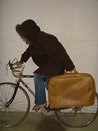
Friends and strangers alike hovered around the racers and everyone wanted to touch the bicycles. And these bicycles showed the innovation and creativity that existed within these individuals and communities.

Speaking of these bicycles, if you’ll let me, I’d like to digress for just a moment. You see, one of the things that never sat well with me when I was in

Anyway, there were no carbon fibre seat posts, no aerodynamic helmets, no yellow jerseys, no cowbells (surprisingly), no one had heard of Cervelo and certainly there were no scandals of blood doping. What there was a sense of community, a sense of competition, innovation, creativity, all in the commonplace of sport. And on this Sunday afternoon, although half a world away, I found a bit of home and a familiarity in people.
Friday, March 23, 2007
out of lusaka and into something more comfortable
“Good Effort! Good Effort!” It was 6:30 in on a Sunday morning. The sun had just found its place on the horizon of Malama area in Southern province and its heat had yet to arrive to beat down our bodies. I was enjoying this morning bicycle ride behind Freeman, the local community livestock worker who was doubling his niece Shonta. His words of encouragement wafted through the air and arrived at my ears as we made our way along the unpaved roads avoiding the mud puddles left over from the rains the day before and fighting through tall grass which at times, concealed the way.

I was into my first week on the job, and this was my third morning in this rural village. I enjoyed leaving the bustle of Lusaka and there’s lots to share about this capital city that has surprisingly a strong western flavour and less chaos than I had expected. But I’m getting a sense of curiosity from you cats back home and I feel that first I should get down to business to answer the million dollar question that has been coming my way. No not ‘is it hot there?’ (which it is by the way) but WHAT AM I DOING HERE?
As with many things in development, the answer isn’t that clear…yet. My focus won’t be firm until sometime in April. Instead, for my first month here, I’ve been given the wonderful opportunity to visit a few field offices to better understand PROFIT operations around the country. During this time, I’m also hoping to better understand rural livelihoods better. This visit to Choma and my stay in Malama area was my first exposure to the bigger PROFIT picture. And so, armed with a list of known unknowns and even more unknown unknowns, I was excited to be entering into my classroom of development learning.
As quick background, EWB volunteers are partnered with existing local organizations; our thinking is that there are some wonderful work happening on the ground so how can we add value to these existing initiatives. In my case, I’m partnered with PROFIT – Production, Finance and Technology. This is a 5 year USAID funded program that is aimed at developing a competitive private sector in Zambia; specifically those industries that have an impact on a large number of small holder farmers as this can contribute to wider poverty reduction.
The importance of agriculture for developing countries like Zambia cannot be underestimated. Approximately 80% of Zambians livelihoods depend on agriculture and 80% of these are classified as small holder farmers. Extreme poverty is most prevalent among this group. In a country of 11 M people, 5 million small holder farmers are classified as poor, and 3.5 M classified as extremely poor (UNDP Zambia Economic policies for growth, employment and poverty reduction, 2006) And so, supporting agriculture can have a massive impact on poverty here in Zambia (and is also why EWB focuses in on organizations that work in this area.
Why private sector? Take a few minutes to think about your daily needs and your daily activities for meeting those needs. Let’s take food for example; you can go to the store to buy it. Or, if you like to garden, then you can go to the local hardware store to purchase the equipment and other inputs that you need. If your local store doesn’t have this, then you can get into your car and drive to another community/store, or you can jump on your bike and ride along the paved road to the next outlet, and the chain goes on. Our lives in Canada are so inextricably linked to markets and our access to these markets are generally so open that we don’t even think about how we’re able to meet our needs through the market systems.
Here in Zambia, the situation is quite different; the private sector is much less developed, and of the markets that are available, access to them by rural communities is limited at best. Decades of heavy government subsidies for agricultural inputs (seeds, fertilizers etc) were followed by a rapid privatization in early 1990s. Where governments once provided required inputs for agriculture, the rate of privatization did not provide enough time for alternative supplies to develop through private sector offerings. Today, noticeably absent is a developed private sector in Zambia, or more specifically, particularly one that reaches out into the rural communities. Rural farmers have limited access to markets where they can gain access to products that can improve their output (fertilizers, herbicides, appropriate technology etc.), or markets where they can sell their crops. I thought I had understood this concept of lack of access to markets prior to arriving but it was hammered home during hours of driving on unpaved, pot hole filled roads that had been recently pummeled by the rainy season – and we had the luxury of a 4x4 vehicle.
Cows, not just for tipping.
Having grown up in rural southwestern Ontario, I was used to cattle. I remember spring days when the smell of cattle manure freshly spread on nearby fields marked the beginning of farming season and I can still hear the lazy moooooos of cows as you road by them on your bicycle. I also heard that if you got the timing right, you could push over cows when they were sleeping.


As I’m here on a professional basis, I had to curb my interest in seeing f this rumour was indeed true. Instead, it was more important to understand what cattle actually mean to rural livelihoods. Here in southern province (and for most of the country) cattle play an important role; provides draft power for farming, milk for added nutrition, mode of transportation (ox drawn carts), or maybe most significantly, cattle ownership carries prestige, is a sign of wealth and effectively, it is a farmer’s bank.
After a good year of harvest or if farmers have extra money on their hands, that money will likely go into the purchase a head of cattle. And conversely, if they require money, (ex. for school fees, if a child is sick), they will then withdraw from their bank by selling off a head of cattle. An average price for a head of cattle is about 1 – 1.2 M kwacha. (about 300$CDN)
One of the vulnerabilities faced by Zambian farmers is the animal’s susceptibility to disease. In the late 80s/early 90’s there was a massive outbreak of corridor disease that wiped out an estimated ¾ of cattle in Monze district of the southern province. Not only did this have direct impact on financial security, it also impacted agricultural production as there was significant dependency on draft power for farming. And today, in the absence of government support, animal health continues to be poor and disease continues to be a major risk factor.
And so, the dipping service that I was riding to with Freeman was part of the Herd Health Plan (HHP) initiative of PROFIT. The end goal of HHP is to improve animal health by linking farmers with private vets. PROFITs role in this is multiple. First, they organize farmers into suitable groups and raise their awareness on the importance of preventative measures for animal health. A common analogy used by these facilitators is this: “ Your animals are your bank. If you don’t protect your animals, then it is like having a bank that does not have a lock on the door, or one where the windows are all broken; thieves can easily come in and steal your money. In your case, the disease is the thief, and so why won’t you protect against them?’


The only condition for participating in the scheme is a willingness to pay – indicating a valuation of service and introducing market system that can promote longer term sustainability of the service and adoption. PROFIT then links farmers up with private vets willing to deliver the required services. Freeman is the community livestock worker who lives in the community and links the farmer and the vet. At the end of the day, the aim is for this farmer/community livestock worker/vet relationship to be strong enough that PROFIT will be able to move out and let this market sustain itself.
So that’s just one example of the work that PROFIT is doing. They’re also working in other industries and focus on system wide changes that need to be in place for growth potential in these markets to be realized and sustained. I mentioned, I’m still not sure where exactly I’ll be focusing but I’m pretty excited that it will fit somewhere into this larger picture.
Anyway, I’ve put in a lot of information and may have also missed out on critical aspects. If you have questions, then by all means post a comment or send me an email and I’d be happy to expand more on this.
Hope all is well. Selani Bwino ( stay well)
Ka-Hay

I was into my first week on the job, and this was my third morning in this rural village. I enjoyed leaving the bustle of Lusaka and there’s lots to share about this capital city that has surprisingly a strong western flavour and less chaos than I had expected. But I’m getting a sense of curiosity from you cats back home and I feel that first I should get down to business to answer the million dollar question that has been coming my way. No not ‘is it hot there?’ (which it is by the way) but WHAT AM I DOING HERE?
As with many things in development, the answer isn’t that clear…yet. My focus won’t be firm until sometime in April. Instead, for my first month here, I’ve been given the wonderful opportunity to visit a few field offices to better understand PROFIT operations around the country. During this time, I’m also hoping to better understand rural livelihoods better. This visit to Choma and my stay in Malama area was my first exposure to the bigger PROFIT picture. And so, armed with a list of known unknowns and even more unknown unknowns, I was excited to be entering into my classroom of development learning.
As quick background, EWB volunteers are partnered with existing local organizations; our thinking is that there are some wonderful work happening on the ground so how can we add value to these existing initiatives. In my case, I’m partnered with PROFIT – Production, Finance and Technology. This is a 5 year USAID funded program that is aimed at developing a competitive private sector in Zambia; specifically those industries that have an impact on a large number of small holder farmers as this can contribute to wider poverty reduction.
The importance of agriculture for developing countries like Zambia cannot be underestimated. Approximately 80% of Zambians livelihoods depend on agriculture and 80% of these are classified as small holder farmers. Extreme poverty is most prevalent among this group. In a country of 11 M people, 5 million small holder farmers are classified as poor, and 3.5 M classified as extremely poor (UNDP Zambia Economic policies for growth, employment and poverty reduction, 2006) And so, supporting agriculture can have a massive impact on poverty here in Zambia (and is also why EWB focuses in on organizations that work in this area.
Why private sector? Take a few minutes to think about your daily needs and your daily activities for meeting those needs. Let’s take food for example; you can go to the store to buy it. Or, if you like to garden, then you can go to the local hardware store to purchase the equipment and other inputs that you need. If your local store doesn’t have this, then you can get into your car and drive to another community/store, or you can jump on your bike and ride along the paved road to the next outlet, and the chain goes on. Our lives in Canada are so inextricably linked to markets and our access to these markets are generally so open that we don’t even think about how we’re able to meet our needs through the market systems.
Here in Zambia, the situation is quite different; the private sector is much less developed, and of the markets that are available, access to them by rural communities is limited at best. Decades of heavy government subsidies for agricultural inputs (seeds, fertilizers etc) were followed by a rapid privatization in early 1990s. Where governments once provided required inputs for agriculture, the rate of privatization did not provide enough time for alternative supplies to develop through private sector offerings. Today, noticeably absent is a developed private sector in Zambia, or more specifically, particularly one that reaches out into the rural communities. Rural farmers have limited access to markets where they can gain access to products that can improve their output (fertilizers, herbicides, appropriate technology etc.), or markets where they can sell their crops. I thought I had understood this concept of lack of access to markets prior to arriving but it was hammered home during hours of driving on unpaved, pot hole filled roads that had been recently pummeled by the rainy season – and we had the luxury of a 4x4 vehicle.
Cows, not just for tipping.
Having grown up in rural southwestern Ontario, I was used to cattle. I remember spring days when the smell of cattle manure freshly spread on nearby fields marked the beginning of farming season and I can still hear the lazy moooooos of cows as you road by them on your bicycle. I also heard that if you got the timing right, you could push over cows when they were sleeping.


As I’m here on a professional basis, I had to curb my interest in seeing f this rumour was indeed true. Instead, it was more important to understand what cattle actually mean to rural livelihoods. Here in southern province (and for most of the country) cattle play an important role; provides draft power for farming, milk for added nutrition, mode of transportation (ox drawn carts), or maybe most significantly, cattle ownership carries prestige, is a sign of wealth and effectively, it is a farmer’s bank.
After a good year of harvest or if farmers have extra money on their hands, that money will likely go into the purchase a head of cattle. And conversely, if they require money, (ex. for school fees, if a child is sick), they will then withdraw from their bank by selling off a head of cattle. An average price for a head of cattle is about 1 – 1.2 M kwacha. (about 300$CDN)
One of the vulnerabilities faced by Zambian farmers is the animal’s susceptibility to disease. In the late 80s/early 90’s there was a massive outbreak of corridor disease that wiped out an estimated ¾ of cattle in Monze district of the southern province. Not only did this have direct impact on financial security, it also impacted agricultural production as there was significant dependency on draft power for farming. And today, in the absence of government support, animal health continues to be poor and disease continues to be a major risk factor.
And so, the dipping service that I was riding to with Freeman was part of the Herd Health Plan (HHP) initiative of PROFIT. The end goal of HHP is to improve animal health by linking farmers with private vets. PROFITs role in this is multiple. First, they organize farmers into suitable groups and raise their awareness on the importance of preventative measures for animal health. A common analogy used by these facilitators is this: “ Your animals are your bank. If you don’t protect your animals, then it is like having a bank that does not have a lock on the door, or one where the windows are all broken; thieves can easily come in and steal your money. In your case, the disease is the thief, and so why won’t you protect against them?’


Farmers meeting at Chief of Monze palace in Malama area.

Community meeting with Malama Community and Chief of Monze - in the hat and suit
(the man's got style!)
(the man's got style!)
The only condition for participating in the scheme is a willingness to pay – indicating a valuation of service and introducing market system that can promote longer term sustainability of the service and adoption. PROFIT then links farmers up with private vets willing to deliver the required services. Freeman is the community livestock worker who lives in the community and links the farmer and the vet. At the end of the day, the aim is for this farmer/community livestock worker/vet relationship to be strong enough that PROFIT will be able to move out and let this market sustain itself.
So that’s just one example of the work that PROFIT is doing. They’re also working in other industries and focus on system wide changes that need to be in place for growth potential in these markets to be realized and sustained. I mentioned, I’m still not sure where exactly I’ll be focusing but I’m pretty excited that it will fit somewhere into this larger picture.
Anyway, I’ve put in a lot of information and may have also missed out on critical aspects. If you have questions, then by all means post a comment or send me an email and I’d be happy to expand more on this.
Hope all is well. Selani Bwino ( stay well)
Ka-Hay
Subscribe to:
Posts (Atom)